
Paddy comes off the field at 20–26% moisture, and the safe storage line is 14% or below (13% for long-term storage). In the dry season, two or three days of pavement drying can barely reach the target — at the cost of mixed impurities, re-wetting after passing showers, and heavy labor. In the wet season, sun drying largely stops working, and the main rice-producing regions of Java, Lampung and South Sulawesi harvest right through the rainy months.
Undried paddy creates two direct losses: mold and aflatoxin risk (wet grain begins heating within 24 hours of piling — see our guide on drying and aflatoxin control), and higher breakage during milling — wet grain cracks in the whitening chambers, head rice recovery falls, and so does the price you get. This is why we recommend Indonesian buyers treat the dryer as the first process step of the rice mill, not an optional accessory.
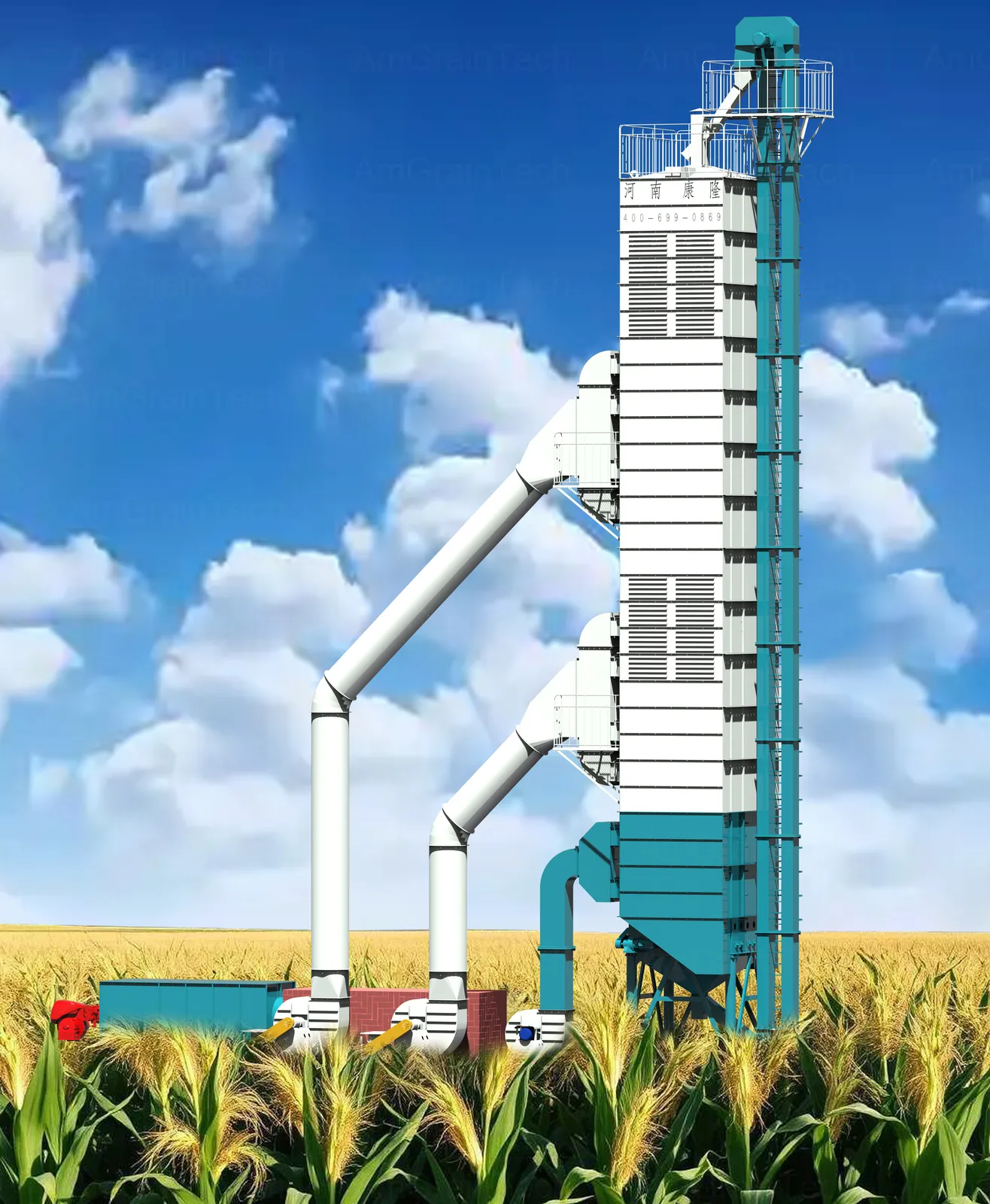
AmGrainTech runs a 130,000 m² production base in Henan, China, with 20+ years of grain machinery export experience across 30+ countries. Drying, steel silo and processing lines are engineered and manufactured in-house; a 200 TPD rice milling project has been delivered in Southeast Asia, and installation and commissioning are carried out by our own engineers — not subcontractors.
1. Size First: Daily Intake Decides the Machine Class
The first step is not a catalog. It is arithmetic: how many tonnes of wet paddy arrive on a peak harvest day? Dryer capacity is rated in tonnes per day (t/d), but real selection needs headroom — peak-day intake typically runs 1.5–2× the daily average. A quick sizing table:
| Your situation | Peak wet-paddy intake | Suggested drying capacity | Typical machine class |
|---|---|---|---|
| Buying station / small rice mill (1–2 t/h milling line) | 30–60 t/day | ~50 t/d | 1–2 batch recirculating dryers |
| Mid-size rice mill (2–5 t/h line) | 60–150 t/day | 100–150 t/d | Multiple batch dryers, or one continuous tower |
| Commercial drying station / collection center | 150–400 t/day | 200–300 t/d | 1–2 continuous drying towers |
| Large storage / government program | 400+ t/day | 300–500 t/d | Tower group plus steel silo complex |
A common trap: mismatch between drying and milling capacity. A 2 t/h milling line running two shifts consumes roughly 30 t of dried paddy per day, which implies about 40–50 t/day of drying once moisture removal and operating hours are considered. Undersized, wet paddy queues and molds; oversized, fuel and depreciation eat the margin. When in doubt, send your harvest calendar and buying radius to the supplier and ask for the calculation — any serious manufacturer will do it.
2. Three Machine Types Compared
| Dimension | Batch recirculating dryer | Continuous drying tower | Mobile dryer |
|---|---|---|---|
| Typical capacity | 10–60 t/d per unit | 100–500+ t/d | 5–20 t/d |
| Moisture uniformity | Good (recirculating + tempering) | Good (multi-stage drying + tempering) | Fair |
| Best for | Mill-dedicated drying, cooperatives | Collection centers, drying-plus-storage projects | Dealers, rental services, start-ups |
| Foundation & footprint | Indoor, shallow foundation | Concrete tower foundation, plus conveying | No fixed foundation |
| Heat source flexibility | All types | All types; large towers favor biomass/gas | Mostly diesel |
| Relative investment | Low–mid | Mid–high | Low (per unit) |
One-line guidance: for your own mill, batch recirculating is the safe default; for a storage business or government project, only a continuous tower spreads the cost; for a first step, start mobile.

3. Heat Source: In Indonesia the Answer Is Often Rice Husk
Indonesian buyers have a natural advantage — rice husk, the by-product of milling, is itself a fuel. Comparing the four mainstream options:
| Heat source | Fuel cost | Initial investment | Maintenance focus | Suits |
|---|---|---|---|---|
| Rice husk / biomass furnace | Very low (own by-product) | Mid (grate + dust handling) | Per-shift de-slagging, grate spares | Mills with their own husk stream |
| Diesel hot-air furnace | High (tracks oil price) | Low | Burner servicing | No biomass; mobile units |
| LPG | Mid–high | Low–mid | Burner and gas-train checks | Stable gas supply, stricter emission zones |
| Natural gas | Mid | Mid (pipeline or gas yard) | Burner tuning | Industrial estates with gas networks |
A mill producing several tonnes of husk per day should default to a husk-fired furnace: fuel cost approaches zero and the husk pile disappears with it. The caveat is operational discipline — furnace temperature and feeding uniformity directly affect hot-air temperature stability, and temperature fluctuation is a hidden driver of broken rice (drying too fast causes kernel cracking). So pair a biomass furnace with automatic temperature control, and make sure operator training is written into the contract. For maintenance planning by heat source, see our heat-source maintenance guide.
4. Electrical and Climate Fit: Two Hard Checks Before Importing
- Electrical: Indonesia runs 50Hz, matching China's standard industrial frequency — a natural fit. Confirm the site voltage level (380V three-phase is typical) and allow for voltage dips in remote areas with stabilizers or soft starters. For 60Hz markets such as the Philippines or Mexico, frequency compatibility must be fixed before ordering — see our guide on 50Hz vs 60Hz compatibility.
- Climate: High heat and humidity attack the machine itself: condensation, damp control cabinets, early coating corrosion. Specify IP54+ electrical enclosures, blast-cleaned steel with heavy anti-corrosion coating, and humidity-rated sensors — in the technical annex at quotation stage, not after arrival.
5. Price Ranges and Budget Composition (Industry Reference)
Prices vary enormously with capacity, heat source and automation. The ranges below are industry-reference figures (public quotations from Chinese exporters and trade media, 2025–2026; for budgeting only, not an offer):
| Class | Equipment investment (industry ref., USD) | Notes |
|---|---|---|
| Batch recirculating 10–15 t/d | $8,000–25,000 / unit | Including hot-air furnace |
| Batch recirculating 30–60 t/d | $25,000–70,000 / unit | Multi-unit parallel common |
| Continuous tower 100–200 t/d | $30,000–120,000 | Depends on tower height and automation |
| Continuous tower 300–500 t/d | $100,000–300,000+ | Including elevating and conveying |
Total budget ≠ machine price. A complete drying system budget has at least six items: the machine itself, auxiliaries (elevators, pre-cleaning, hoppers, controls), sea and inland freight, civil foundation, installation and commissioning, plus training and wear parts. Auxiliaries and installation are the two most underestimated items — ask for an itemized quotation and check every "included / not included" line before comparing totals.
6. Lead Times: From Inquiry to First Drying Run
- Inquiry and proposal (1–2 weeks): send harvest calendar, daily intake, site conditions and grid parameters; get a sizing proposal and itemized quotation.
- Contract and production (4–10 weeks): standard models 4–6 weeks; large towers or custom configurations 8–10 weeks.
- Sea freight and customs (3–5 weeks): main Chinese ports to Jakarta / Surabaya / Medan take roughly 2–3 weeks at sea, plus 1–2 weeks clearance and inland transport.
- Civil works (in parallel with production): the supplier provides foundation drawings; local construction runs while the machine is being built.
- Installation, commissioning and training (2–4 weeks): confirm the supplier sends its own engineers — this decides commissioning quality and follow-up response.
From contract to first run: about 2–3 months for small units, 4–5 months for large tower projects. If the goal is commissioning before the peak harvest, start the inquiry a full quarter ahead.
7. Three Actions for Indonesian Buyers
- Send wet-paddy sample data first (variety, harvest moisture, target moisture) and let the supplier verify the machine against your moisture-removal duty — instead of asking "how much is a 100-ton dryer".
- Put installation and training into the contract, including engineer days on site and travel terms — avoid the "machine arrived, nobody can start it" situation.
- Match the heat source to your by-products — with husk available, a husk furnace turns a waste problem into near-free fuel; the fuel cost curve decides whether the drying business earns.