
Corn Silos — Steel Storage Built for Your Harvest
Flat-bottom corn silos 50–20,000+ t · hopper-bottom holding silos for processors · aeration & temperature control · corn silo cost estimates sized to your harvest

Why corn needs a purpose-planned silo
Corn comes off the field at 18–30% moisture and must be dried to the 13–14% safe-storage range before it goes into the bin — wet corn sealed in storage spoils fast and risks aflatoxin. That is why a corn silo is never just a tank: it needs matched aeration, in-silo temperature monitoring, and cleaning ahead of intake. Hot-dip galvanized steel construction gives a 15–25 year service life, and with temperature-controlled ventilation corn can be held safely for 1–3 years without spoiling.
Which silo type fits your corn operation?
| Silo type | Capacity range | Best for corn when… |
|---|---|---|
| Flat-bottom steel silo | 50–20,000+ t | You store dried corn long-term — farm collection, commercial depots, port transshipment. Lowest cost per tonne at scale. |
| Cone-bottom (hopper) steel silo | 5–2,000 t | Corn flows out by gravity, no residue — feed mills, starch and flour processors, wet-corn holding ahead of the dryer. |
| Insulated steel silo | Custom | Big day-night temperature swings cause condensation and mold on stored corn — constant-temperature storage without concrete cost. |
Flat-bottom corn silos — large-scale dried-corn storage
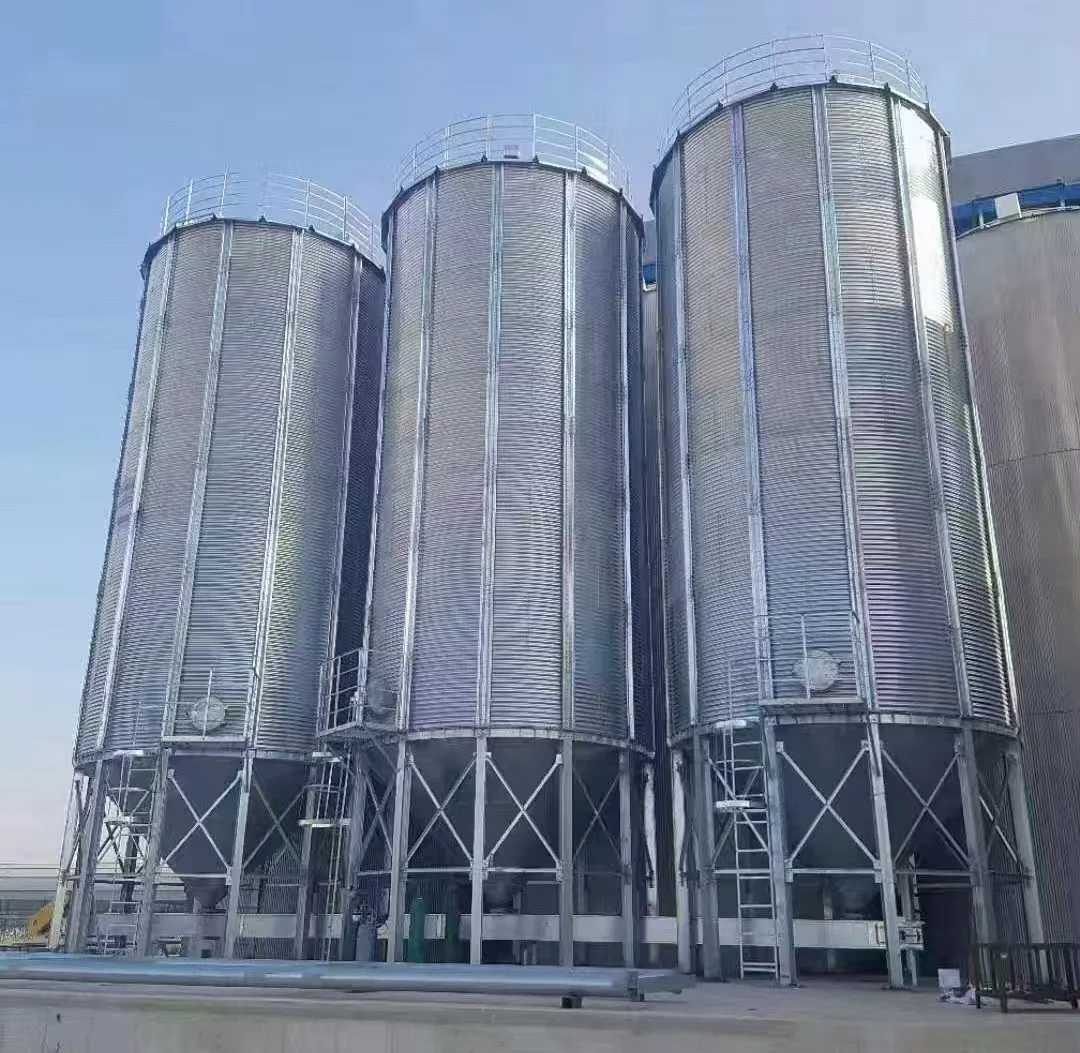
Assembled on site from hot-dip galvanized corrugated steel plate with high-strength bolts — no on-site welding, fast to erect, relocatable, and modular for phased expansion. Diameters from 5.5 m to 31.4 m with single-silo capacity beyond 20,000 tonnes, serving grain depots, port transshipment, and large corn buyers.
Key advantages: bolt-together modular body; complete ventilation, temperature, and humidity monitoring for safe long storage; 30° roof angle; 15 diameter specifications across the range.

Representative specifications
| Silo diameter (m) | Eave height range (m) | Capacity range (t) | Typical corn application |
|---|---|---|---|
| 7.3 | 3.7–22.0 | 120–1,200 | Farms, cooperatives, small collection points |
| 12.8 | 5.5–31.4 | 500–5,000 | County depots, corn processors' reserve silos |
| 18.3 | 7.3–31.4 | 1,500–12,000 | Provincial reserve depots |
| 24.0 | 7.3–31.4 | 2,500–18,000 | Port transshipment, large corn traders |
| 31.4 | 9.2–31.4 | 5,000–20,000+ | National strategic grain reserves |
Full diameter range 5.5 m–31.4 m across 15 specifications. Larger diameters and capacities available on request — contact our engineers for sizing.
Hopper-bottom corn silos — gravity discharge for mills and wet-corn holding
The 45°/60° cone bottom lets corn discharge completely under its own weight — no residue, no sweeping, lower foundation cost. Ideal as raw-material silos for feed mills, starch plants, and flour mills, or as buffer bins holding corn ahead of drying and cleaning lines.
Representative models
| Model | Diameter (m) | Approx. height (m) | Volume (m³) | Capacity (t) |
|---|---|---|---|---|
| AGT-TCZ305-3 | 3.05 | 7.5 | 29.7 | 22.3 |
| AGT-TCZ457-3 | 4.57 | 8.5 | 68.0 | 51.0 |
| AGT-TCZ550-4 | 5.5 | 10.0 | 120.0 | 90.0 |
| AGT-TCZ730-5 | 7.3 | 13.0 | 250.0 | 187.5 |
| AGT-TCZ910-5 | 9.1 | 15.0 | 400.0 | 300.0 |
Full cone-bottom range: diameters 1.8 m–9.1 m across 17 models. A small farm feed-tower series (AGT-WX, 2.6–54 t) is also available.
Corn-specific auxiliary systems — storage is more than the silo body
Aeration & temperature control
Bottom centrifugal fans + roof induced-draft fans cool the grain column and even out moisture. Multi-point temperature cables monitor in-silo corn temperature in real time with auto-alarm; a recirculation fumigation system is optional for pest control.
Cleaning before the bin
Cylinder pre-cleaners (SCQY, 10–300 t/h), vibrating screens (TQLZ, 20–260 t/h), destoners (TQSF, 4.5–30 t/h), and magnetic separators (TCXT, 5–75 t/h) take fines and foreign matter out of corn before storage — cleaner grain stores safer.
Conveying & elevating
Bucket elevators TDTG series (15–1,500 t/h), enclosed scraper conveyors TGSS series (25–1,600 t/h), air-cushion belt conveyors QDJ/SQDJ series (50–4,500 t/h), screw conveyors TLSS series — sized to any silo group.
Dry it before you store it
Corn at 18–30% harvest moisture needs drying down to 13–14% first. Pair your corn silo with our continuous tower dryers or batch dryers — see grain drying equipment — for a complete harvest-to-storage line.
Major customers
Long-term domestic partners: COFCO Group, Yihai Kerry (Wilmar), Beidahuang Group, Hualiang Group, National Grain Reserve, Wens Group, Muyuan Group, Haid Group, New Hope Group, Jinmailang, Keming, White Elephant, Xiangnian, Jinshahe
Overseas exports: South Africa, Indonesia, Laos, Thailand, Russia, Kenya, Bangladesh, the Philippines, and 30+ other countries
Service & warranty
| Service item | Commitment |
|---|---|
| Warranty period | 1-year warranty |
| Technical support | Lifetime free technical support |
| On-site response | Response within 24–48 hours |
| Spare parts | Common spare parts stocked long-term |
Get a corn silo cost estimate
Tell us your annual corn harvest, storage tonnage, and turnover frequency — our engineers will size the silo group and give you a costed proposal, from single bin to full storage facility.